 Recete
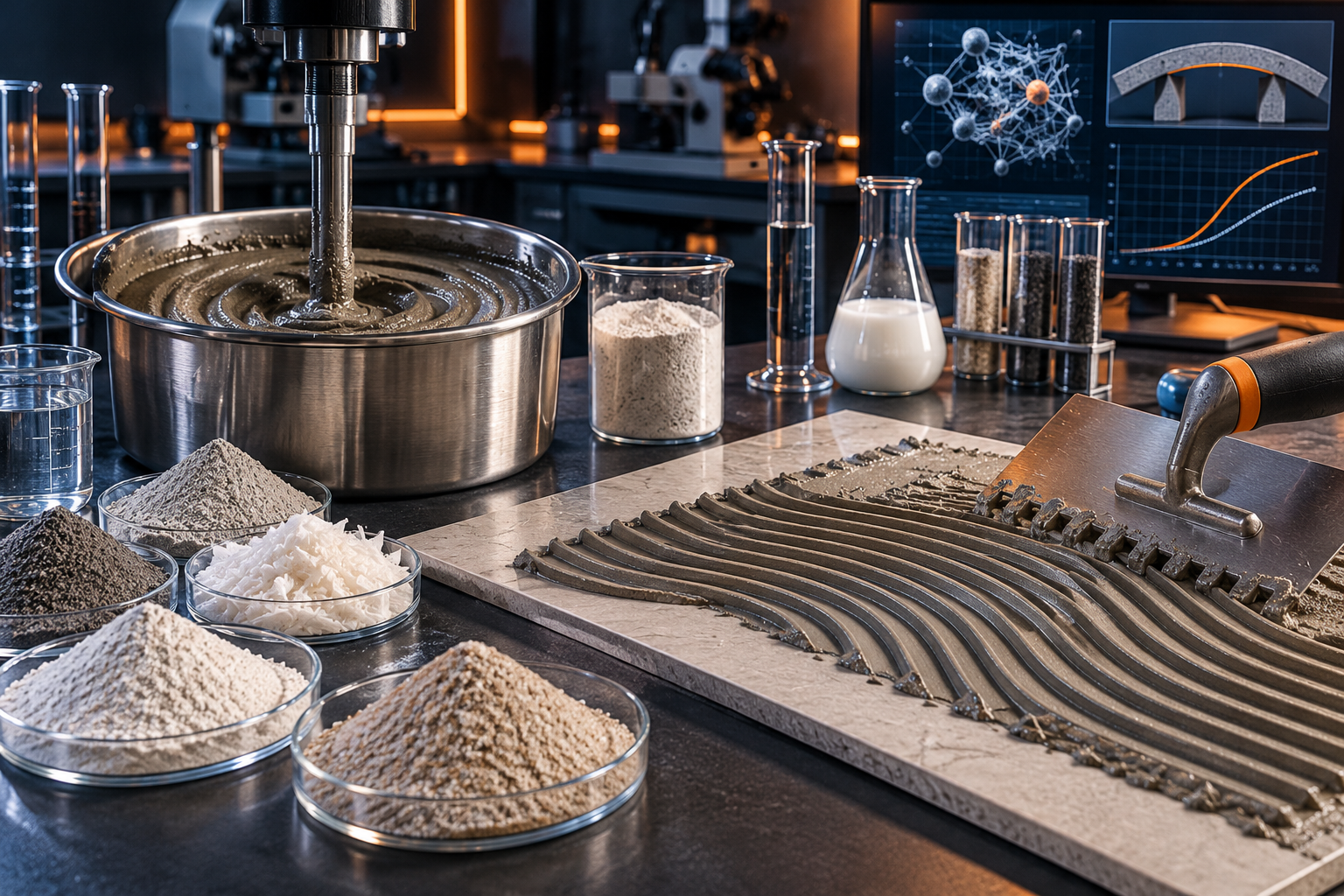
C2TES1 is not simply a tile adhesive with “more polymer”
One of the most common mistakes in developing a C2TES1 tile adhesive is assuming that the target performance can be achieved simply by increasing RDP dosage. In practice, C2TES1 requires several interacting performance criteria to be balanced within the same formulation.
For S1, transverse deformation is at least 2.5 mm and less than 5 mm. The development objective is therefore to balance adhesion, open time, slip resistance, workability, deformability, manufacturability and cost in one system.
C2TES1 formulation must be treated as a system
Tile adhesive performance is not the result of a single raw material. A simplified view is:
Changing one component can affect several properties at once. A change in water demand may alter workability, consistency, ridge stability, drying behavior and final mechanical properties. Increasing polymer may improve deformability, but its effects on cost, rheology, setting and application behavior must also be assessed.
C2TES1 development should begin with “how do these raw materials behave together?” before asking “how much of each additive should we use?”
1. The role of RDP in a C2TES1 system
Redispersible polymer powder (RDP) is a key component of high-performance cementitious tile adhesives. After mixing with water and hardening, the polymer phase contributes to modifying the mechanical behavior of the cementitious mineral matrix.
In C2TES1 development, RDP is particularly associated with adhesion, deformability, compatibility with different substrates, retention of performance after conditioning, and reduced brittleness. Dosage alone, however, is not sufficient: polymer chemistry, glass-transition characteristics, flexibility and compatibility with the cement system also matter.
An unsuitable polymer can fail to deliver the required cost/performance balance even at a high dosage.
2. How is S1 deformability developed?
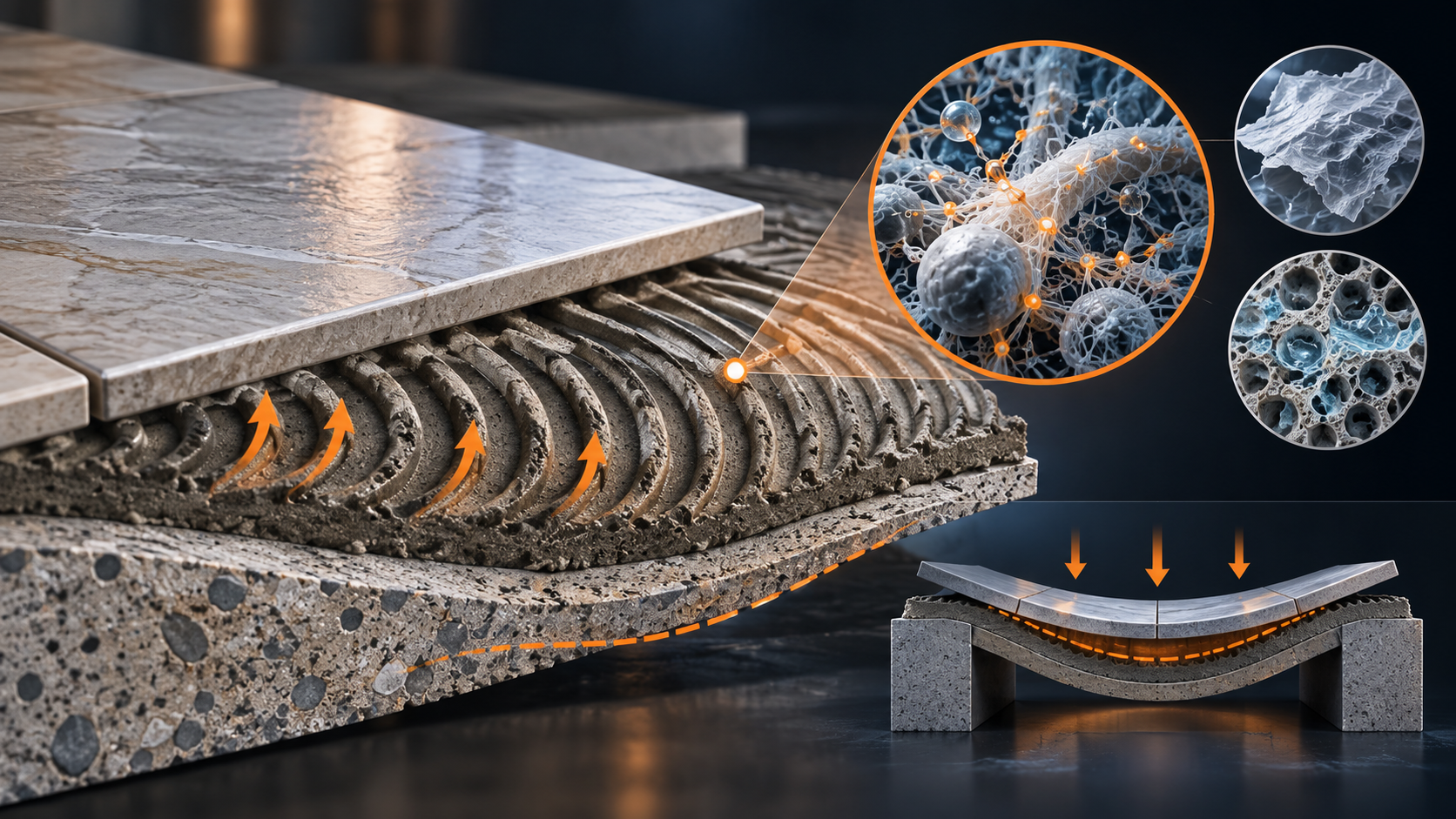
S1 should not be interpreted simply as “adding enough polymer.” The deformation behavior of the hardened adhesive is governed by the polymer phase + cement matrix + aggregate/filler structure + water-to-binder and water-to-solids relationships + hydration + porosity.
The goal is not merely to produce a soft mortar. The adhesive must deform while maintaining the required C2 adhesion performance. An excessively rigid mineral structure can make the S1 target difficult to reach even with polymer, while over-polymerizing the system can raise cost unnecessarily.
S1 performance should be engineered through the interaction of the mineral and polymer phases, not through polymer dosage alone.
3. Why is cellulose ether more than a thickener?
Treating cellulose ether only as a thickener is a significant formulation error. Appropriate HPMC/HEMC systems can strongly influence water retention, workability, open time, slip resistance and application behavior.
Selection should not be based on viscosity alone. Two cellulose ethers with the same nominal viscosity can behave differently in tile adhesive because of their modification level and rheological profile.
4. The relationship between open time and adhesion
The E in C2TES1 denotes extended open time. This becomes particularly important in hot conditions, large-area applications and large-format tile installation. Once mortar is combed onto the substrate it begins losing water; as surface skinning progresses, adequate wetting and transfer to the back of the tile can become more difficult.
Open time should therefore not be addressed simply by increasing cellulose ether. Cellulose ether type → water retention → mixing water → cement hydration → surface drying → ambient temperature → RDP system → rheology must be evaluated together.
5. Balancing slip resistance and workability
The T denotes reduced slip. In wall applications, the tile should not move downward after placement. Yet over-structuring the mortar to control slip can create heavy troweling, excessive resistance, poor transfer and a mortar perceived as too stiff by the applicator.
A well-designed C2TES1 should combine low slip + easy troweling + adequate wetting + good transfer + controlled creamy consistency.
6. Why is water a critical formulation parameter?
Water is not merely an applicator adjustment; the target water demand is part of the formulation. Small changes can influence workability, slip, open time, ridge stability, porosity and mechanical performance.
Rather than testing at only one water level, laboratory development should evaluate behavior across an acceptable water-tolerance range. Field users will not dose water with laboratory precision.
7. Why aggregate and mineral filler cannot be ignored
Attention in C2TES1 often focuses on RDP and cellulose ether, although the mineral phase makes up most of the product. Aggregate grading, maximum particle size, particle shape and their effect on water demand directly influence application behavior.
Well-designed mineral packing can provide more controlled water demand + improved workability + more stable trowel ridges + better cost balance. Compensating for poor mineral design with expensive chemical additives is rarely economical.
8. How should C2TES1 be developed in the laboratory?
A common development error is changing too many raw materials at the same time. Even if performance improves, the contribution of each variable becomes unclear. A controlled experimental matrix is more informative.
Alongside standardized test results, record mixing behavior, wetting, consistency, trowel feel, ridge stability, slip, transfer, skinning tendency, open time and hardening behavior. A commercially successful product must be manufacturable, applicable, repeatable and economical, not merely capable of passing a test.
9. Why can a laboratory formulation change at factory scale?
A kilogram-scale laboratory mix and an industrial batch measured in tonnes do not share the same physical environment. Mixer geometry, fill ratio, mixing time, addition sequence, distribution of low-dose additives, raw-material temperature and moisture can all change product behavior.
Homogeneous distribution of cellulose ether and other low-dose functional additives can be particularly critical. Development should therefore not end with simply sending a formula to the factory.
10. Cost optimization: the cheapest formula or the most efficient system?
RDP, cellulose ether and other functional additives can account for a significant share of C2TES1 cost. The first cost-reduction attempt is often to reduce RDP, but poorly designed optimization can lower performance and require additional additives, making the system expensive again.
A more robust approach is to evaluate the full chain: cement → mineral packing → water demand → RDP efficiency → cellulose ether → functional additives → production process.
The objective is not the lowest cost per kilogram, but the most efficient formulation system that reliably delivers the target C2TES1 performance.
The core principle in C2TES1 development
A successful C2TES1 tile adhesive does not depend on a single “miracle” raw material. RDP is part of the adhesion and deformability system; cellulose ether is central to water retention, rheology, open time and application behavior; and the mineral phase forms the mechanical and rheological skeleton. Water changes the behavior of the entire system, while the production process determines whether laboratory performance can be reproduced industrially.
Real formulation engineering is less about selecting individual raw materials and more about managing the interactions between them.
We do not treat C2TES1 development as simply writing a formula.
Depending on project scope, our work can include raw-material selection, formulation development, laboratory optimization, EN 12004-oriented verification, cost optimization, QC criteria, pilot production and industrial scale-up.
Explore Tile Adhesive Formulation Consulting