 Reçete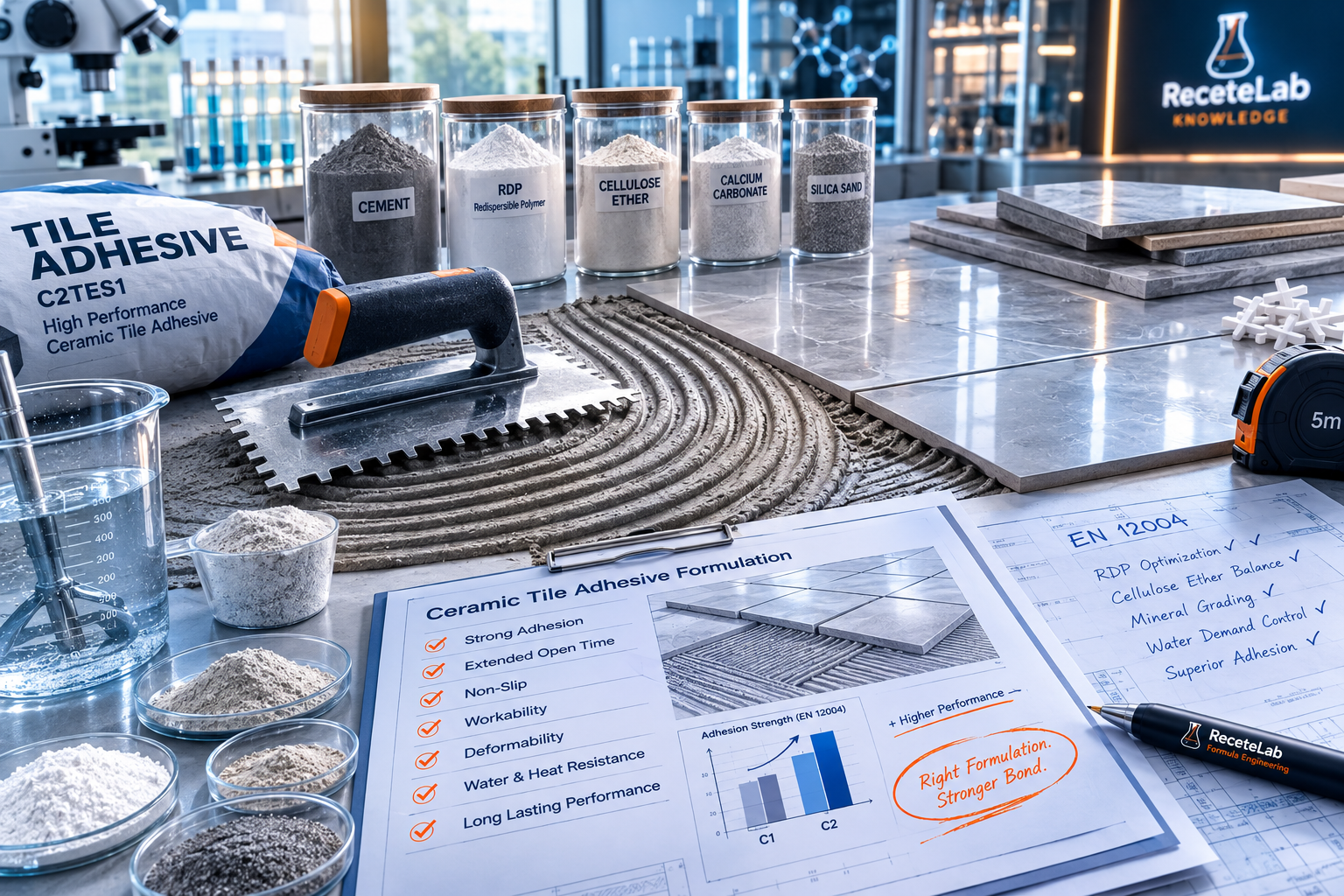
Low adhesion in a cementitious tile adhesive is rarely caused by one missing raw material. Increasing cement, polymer or cellulose ether may temporarily improve a result, but changing dosage before identifying the root cause can increase formulation cost and create new performance problems.
For C1 and C2 cementitious tile adhesives developed around EN 12004 performance requirements, adhesion is the result of the complete system: binder chemistry, polymer modification, water retention, mineral grading, water demand, open time and application conditions.
The right question is not “Which additive should we increase?” but “What is actually causing the loss of adhesion?”
Why Adhesion Must Be Evaluated as a System
Initial adhesion alone does not describe a robust tile adhesive. Performance after water immersion, heat ageing, freeze-thaw exposure and extended open time can reveal weaknesses that are invisible in an initial test.
A product may show strong initial tensile adhesion and still lose substantial performance after conditioning. This often indicates an unbalanced formulation or excessive dependence on one component.
1. Wrong Polymer Selection or Insufficient Polymer Dosage
Redispersible polymer powder (RDP) is a key performance component in modern cementitious tile adhesives. It can improve adhesion, flexibility, deformation capacity and interfacial bonding.
But more RDP does not automatically mean better adhesion. Polymer chemistry, glass-transition behaviour, cement compatibility and effective dosage all matter. Two RDP grades at the same kg/t dosage can deliver very different results.
The useful engineering relationship is therefore polymer type × dosage × binder system × target performance.
2. Insufficient Water Retention
Mixing water is required not only for workability but also for cement hydration. On absorbent substrates, rapid water loss can weaken hydration at the adhesive/substrate interface and reduce open time and adhesion.
Cellulose ether is critical here, but viscosity alone is not enough to specify the correct grade. Products with similar viscosity can differ in water retention, air entrainment, rheology and open-time behaviour. Selection should therefore be based on application performance, not a single datasheet value.
3. Open Time Is Not Under Control
One of the most common field causes of low adhesion is placing the tile too late after the adhesive has been combed. Once a skin begins to form, wetting and transfer to the tile can fall sharply even while the mortar still appears soft.
The combination of high temperature, low relative humidity, air movement and absorbent substrates can shorten effective open time significantly. This is particularly important for products developed for hot climates such as the Gulf and wider Middle East.
4. Incorrect Water-to-Powder Ratio
The recommended mixing-water range is part of the formulation. Excess water can increase porosity, affect slip and shrinkage, reduce mechanical strength and weaken adhesion. Too little water can prevent adequate wetting and hydration.
The objective is therefore the optimum water-to-powder ratio that delivers workability and substrate/tile wetting without unnecessary water demand.
5. Poor Aggregate and Filler Design
Most of the mass of a tile adhesive is mineral. Particle size, grading, shape, surface area and water demand therefore have a major influence on rheology and formulation efficiency.
An inefficient mineral skeleton may require more water or more chemical additives. Better particle packing can improve consistency and allow a more efficient binder/additive package. A high-performance tile adhesive needs not only good additives, but also a well-designed mineral skeleton.
6. Cement Changes but the Formula Does Not
A formulation developed with one cement can behave differently after a change of supplier, plant, clinker characteristics or fineness—even when the nominal cement class remains the same.
Cement variation can affect water demand, setting, cellulose-ether interaction, dispersion, open time and adhesion development.
When a critical raw material changes, the system should be revalidated.
7. The Problem May Be Application, Not Formulation
Not every field complaint is a recipe problem. Dusty substrates, high absorption, incorrect trowel notch, poor adhesive transfer, excessive open time, hot surfaces, incorrect mixing, insufficient maturation or retempering with additional water can all reduce adhesion.
| Potential source | What to check |
|---|---|
| Formulation | Binder, polymer, cellulose ether and functional additives |
| Raw materials | Changes in cement, sand, fillers and additives |
| Production | Dosing accuracy, mixing time and homogeneity |
| Application | Water dosage, mixing and open time |
| Substrate | Absorption, temperature and cleanliness |
| Environment | Temperature, humidity and air movement |
Moving from C1 to C2 Is Not Simply Adding More Polymer
A common shortcut is to think of a C2 formulation as a C1 formula with additional RDP. In practice, binder balance, polymer modification, water retention, open time, mineral packing and application behaviour must be developed together.
The goal is not to pass one isolated test limit. It is to create a repeatable, manufacturable performance system.
How Should a Low-Adhesion Problem Be Diagnosed?
- Define the target performance: identify the required product class and application conditions.
- Review the current formulation: evaluate binder, mineral system, polymer, cellulose ether and additives together.
- Check raw-material changes: especially cement, sand, filler, RDP and cellulose ether.
- Review production records: dosing accuracy, mixing time and batch homogeneity.
- Reproduce field conditions: investigate the complaint under realistic temperature, substrate and application conditions where possible.
- Use controlled single-variable trials: changing many materials simultaneously makes root-cause identification difficult.
Higher Adhesion or the Right Adhesion?
The objective of formulation engineering is not always the highest possible laboratory number. Excess polymer can produce very high adhesion while unnecessarily increasing product cost.
A commercially robust formulation should meet standard requirements + an appropriate safety margin + application reliability. Unnecessary over-performance is also a cost.
From Laboratory to Production
A successful formulation must remain stable through the entire chain: Raw Materials → Dosing → Mixing → Packaging → Storage → Application.
Laboratory validation → Pilot production → Industrial production → Field validation
Experiencing Low Adhesion in Your Tile Adhesive?
The first response should not be random additive increases. The target standard, current formulation, raw materials, production conditions and field complaint should be reviewed together.
ReçeteLab supports tile-adhesive and cementitious construction-chemical manufacturers with formulation development, performance optimization, cost engineering and production troubleshooting.
Related expertise: Formulation Engineering →
Start a technical assessment