 Reçete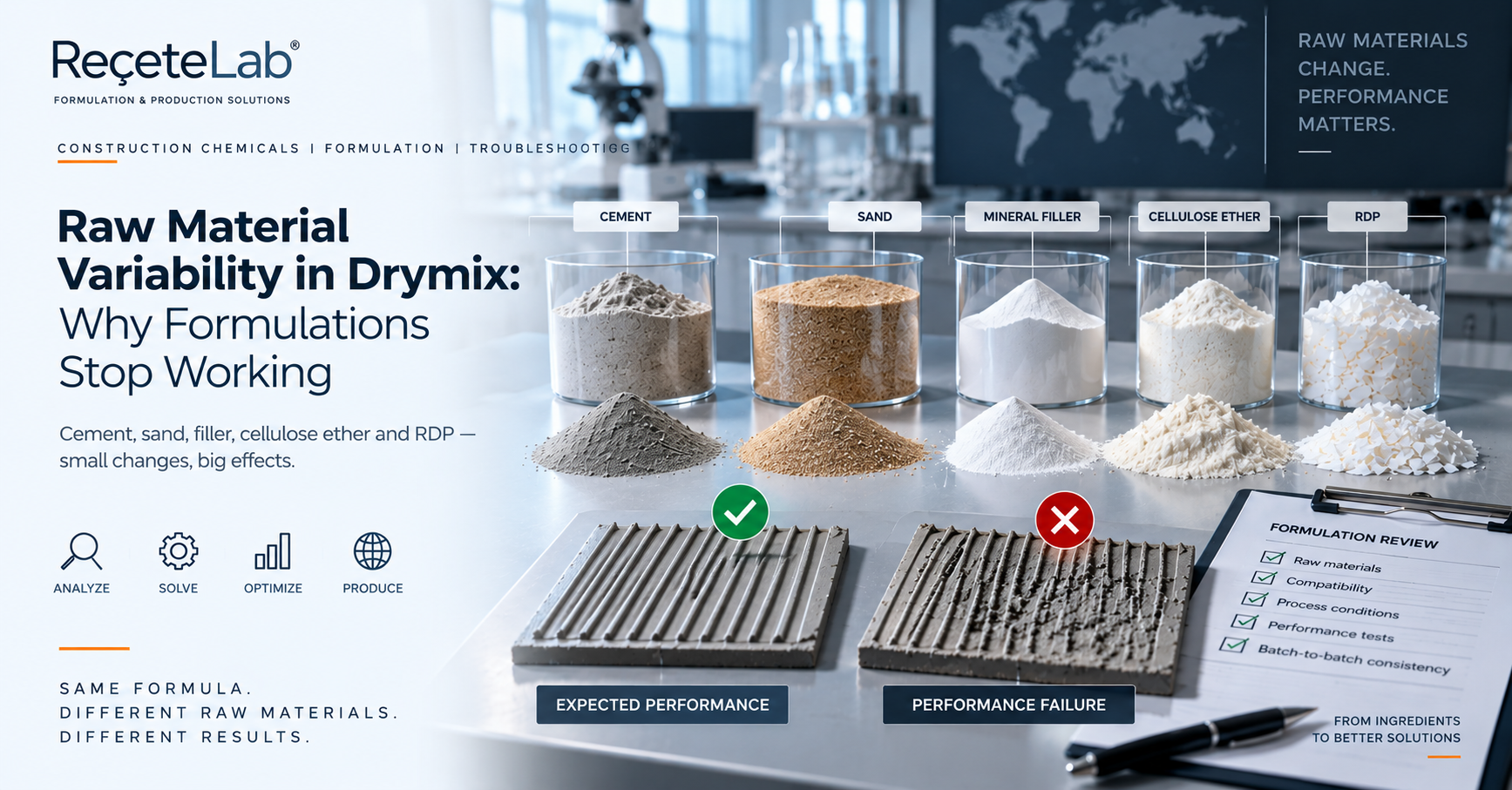
One of the most frustrating problems in drymix manufacturing is a formulation that has worked for months and then starts behaving differently even though the recipe has not changed. The instinctive response is to adjust the formulation. In many cases, however, the formula is not the first thing that changed—the raw materials are.
Cement, graded sand, mineral fillers, cellulose ethers, redispersible polymer powders (RDP) and functional additives can vary between suppliers and between production lots from the same supplier. Those differences can alter water demand, rheology, setting, open time, adhesion, flow and mechanical performance.
The same recipe does not necessarily produce the same product when the raw-material behaviour has changed.
1. Why Can an Unchanged Drymix Recipe Give Different Results?
Drymix performance is generated by interactions between raw materials rather than by specification-sheet values in isolation. Two cements may carry the same strength class; two cellulose ethers may show a similar nominal viscosity; two RDP grades may belong to a similar polymer family. Their behaviour inside the complete formulation can still differ.
A small shift in one component can influence water demand, water retention, wetting, rheology, hydration kinetics, air content, setting, open time, adhesion and deformability at the same time. Troubleshooting therefore requires a system view.
2. Cement Variation: More Than Strength Class
Cement fineness, mineralogy, C₃A/C₃S balance, sulfate balance, alkali content and setting behaviour can affect both hydration and interaction with cellulose ether, superplasticizers and set-control additives. After a cement source or lot change, the same formulation may show different water demand, consistency, setting time, open time or adhesion.
Checking compressive strength alone is not enough. The formulation should be revalidated against the new cement under the product's actual performance criteria.
3. Sand and Aggregate: Particle-Size Distribution Matters
Nominal labels such as 0–0.5 mm or 0–1 mm do not fully describe an aggregate. Particle-size distribution, fines content, particle shape, mineralogy, surface area and moisture can all change mortar behaviour. An increase in fines raises total surface area and can increase water demand.
Adding more mixing water may restore apparent workability while reducing adhesion, strength or dimensional stability. For that reason, old and new aggregate curves should be compared rather than relying only on nominal grading.
4. Mineral Fillers Can Shift Rheology and Water Demand
Calcium carbonate and other mineral fillers may appear to be simple volume components, but changes in fineness and particle-size distribution can affect consistency, flow, pumpability and trowel feel. The effect is particularly important in self-levelling compounds, fine repair mortars and high-performance tile adhesives.
5. Cellulose Ether: Same Viscosity Does Not Mean Same Performance
Replacing one cellulose ether with another solely on the basis of viscosity is a common formulation mistake. Modification level, dissolution behaviour, water retention, rheological profile, air entrainment and interaction with cement can differ. A kilogram-for-kilogram substitution can therefore change slip resistance, open time, trowelability and adhesion.
6. RDP: Polymer Powder Is Not a Commodity
Redispersible polymer powder influences adhesion, flexibility, cohesion, water resistance and workability. Polymer chemistry, protective colloid system and product design matter. Two RDP grades used at the same dosage do not automatically provide equivalent performance, particularly in C2-class and deformable tile adhesive systems.
7. Is the Raw Material Really the Root Cause?
Raw-material change is an important suspect, but similar symptoms can be produced by dosing drift, weighing errors, inadequate or excessive mixing, mixer fill level, raw-material moisture, storage conditions, charging sequence and packaging conditions.
Formulation + raw materials + manufacturing process must be evaluated together.
8. A Practical Change-Control Method
- Compare the old and new raw-material specifications and retained samples where available.
- Change one variable at a time in controlled laboratory trials.
- Measure product-specific indicators such as water demand, consistency/flow, density, water retention, setting, open time, adhesion, strength or deformability.
- Run a pilot or first industrial batch under controlled process conditions.
- Compare laboratory and factory samples using the same test method.
- Define incoming-material acceptance limits for the variables that actually affect performance.
9. Should the Formula Be Changed Immediately?
Not necessarily. Randomly increasing polymer or additive dosage can hide the symptom while raising cost or creating a second problem. First identify whether the deviation originates from the raw material, formulation, process or application conditions. Sometimes a small formulation adjustment is enough; sometimes the replacement raw material is simply unsuitable for the system.
10. Designing More Robust Drymix Formulations
An industrial formulation should not only pass a laboratory test. It should tolerate reasonable raw-material and process variation while maintaining the required product specification. The engineering target is a balance between performance, manufacturing repeatability, raw-material tolerance and total cost.
From Symptom to Root Cause
When a previously stable drymix product changes, the most useful question is not only “What changed in the recipe?” It is also “What changed in the raw materials and production conditions?” This approach is relevant to tile adhesives, self-levelling compounds, repair mortars, renders, waterproofing mortars and other cementitious drymix systems.
Did Your Product Change After a Raw-Material Switch?
ReçeteLab evaluates formulation, raw-material behaviour and production conditions together to identify the likely root cause and define a controlled optimization path.
Formulation Engineering · Drymix Technology · R&D Troubleshooting
Request an initial technical assessment